





Crooked, crowded or gappy teeth are not just a childhood concern. Teeth straightening for adults addresses crowding, spacing and bite problems in a fully matured mouth, and there is no upper age limit on getting started. Some adults pursue it for functional reasons, such as a bite that makes chewing awkward, while others simply want a smile they feel confident sharing. Whatever the motivation, the modern range of options means treatment can fit around a working, social adult life far more comfortably than many people expect.
More adults than ever are exploring straightening later in life, partly because discreet options now exist and partly because people increasingly understand that alignment affects more than looks. Perhaps you wore braces as a teenager and your teeth have slowly drifted since, or perhaps you never had treatment and have decided the time is finally right. Either way, understanding what each option involves, how long treatment realistically takes and what to consider before committing will help you have a far more productive first conversation with your dentist.
Before we look at each option in detail, here is a quick overview of the essentials:
- Adult teeth straightening targets crowding, spacing or bite issues in fully developed teeth and jaws.
- Treatment suits adults of any age, and motivations range from function to appearance, or both.
- Several approaches exist, including metal, ceramic and lingual braces plus clear aligners, each with its own visibility trade-offs.
- Timelines, complexity and cost vary with the individual case and the method chosen.
- An initial consultation with a dentist is the sensible starting point.
What Are the Main Teeth Straightening Options for Adults?
The teeth straightening options for adults fall into two broad categories: fixed appliances (braces) and removable trays (clear aligners). Both work in the same fundamental way, applying controlled, incremental pressure to teeth over an extended period so they gradually move into better positions. The bone around each tooth remodels in response to that gentle, sustained force, which is why straightening is always measured in months rather than days. The right choice for any individual depends on how severe the misalignment is, how the appliance fits into their lifestyle, and how much visibility they are comfortable with. Orthodontic treatment is provided by dentists who practise orthodontics and by specialist orthodontists, with general dentists frequently managing straightforward cases alongside referring more complex presentations.
Metal braces
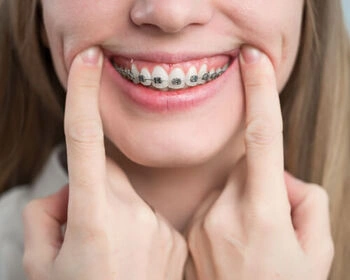
Traditional metal braces use stainless steel brackets bonded to the front of each tooth, connected by a wire that delivers steady, continuous pressure. They remain a workhorse of orthodontics because they handle complicated cases well, including significant crowding and bite discrepancies. They are also among the most affordable options available. The trade-off is visibility, and they require periodic adjustment appointments throughout active treatment so the clinician can tighten or replace the wire as teeth move.
Ceramic braces
Ceramic braces work on exactly the same mechanism as metal braces, but the brackets are made in a shade that matches the teeth, making them far less obvious at conversational distance. This makes them a popular choice for working adults who want the strength of a fixed appliance without visible metal. They do demand a little more maintenance, and the brackets or the elastic ties around them can discolour over time if staining foods and drinks feature heavily in the diet.
Lingual braces
Lingual braces are fixed to the inner (tongue-side) surfaces of the teeth, which makes them nearly invisible from the front. That discretion appeals strongly to professionals and socially conscious adults. They do come with an adaptation period, since the tongue sits against the brackets, and speech and comfort can take a couple of weeks to settle. They are also not appropriate for every case, so suitability needs to be confirmed through clinical assessment.
Clear aligners
Clear aligners, including well-known systems such as Invisalign, SPARK and Angel, are a series of custom-moulded, transparent plastic trays. Each tray in the series moves the teeth a small step closer to their target positions. Because these removable orthodontic appliances come out for eating and cleaning, daily life carries on much as normal. Aligners are effective for mild to moderate cases, while complex presentations may still be better served by fixed appliances. Suitability is always determined case by case, which is why an assessment comes first. If you are weighing up aligners and wondering about comfort, our guide on whether Invisalign hurts walks through what the adjustment period actually feels like.

Does Teeth Straightening Affect Oral Health, Not Just Alignment?
It is easy to think of straightening as purely cosmetic, but alignment and oral health are closely linked. Crowded or overlapping teeth create tight, awkward zones that a toothbrush and floss simply cannot reach properly. Over time, that poor access encourages plaque to accumulate, which raises the risk of tooth decay and gum (periodontal) disease. Straighter teeth with better spacing are genuinely easier to keep clean, so orthodontic correction can improve the effectiveness of your everyday brushing and flossing. For adults who have battled the same trouble spots at every hygiene visit for years, this can be one of the most practical benefits of treatment.
Alignment also matters for how your teeth work together. A corrected bite distributes chewing forces more evenly across the dental arch, which can reduce uneven wear on individual teeth. That said, orthodontic treatment is not automatically necessary for everyone. Plenty of people have mildly crooked teeth that cause no functional or hygiene problems at all, and the functional, hygienic and aesthetic impacts differ from case to case. A dentist can help you understand whether misalignment is actually affecting your oral health or is purely a cosmetic preference. It is also worth remembering that straightening changes position, not colour; if staining is part of what bothers you about your smile, our article on the common causes of yellow teeth covers that side of the picture.
What Affects Treatment Duration and Complexity?
Adult treatment timelines typically span anywhere from several months to a couple of years or more. One honest difference between adult and childhood orthodontics is speed: because adult bone is fully mature, teeth migrate more slowly than they do in growing jaws. This is entirely expected and does not make treatment any less predictable; it simply means timelines are set realistically from the start.
Several factors influence how long treatment takes:
- The degree of correction needed. More crowding, wider spacing or a larger bite discrepancy means more tooth movement, and more movement takes longer.
- The option selected. Fixed appliances and removable trays apply force differently, and some movements are achieved faster with one than the other.
- Compliance, if aligners are chosen. Clear aligners only work while they are being worn, and the standard protocol is 20 to 22 hours a day. Trays left in the drawer do not move teeth.
- Pre-treatment dental needs. Any active decay or gum disease must be managed before orthodontic work begins, which can add time at the front end.
There is also a final phase that every adult should factor in: retention. Once active treatment finishes, retainers hold teeth in their new position and prevent them drifting back, a process called relapse. Retainers are a long-term commitment, but a small one compared with repeating treatment. Depending on the case, retention might involve a slim wire bonded behind the front teeth, a removable retainer worn at night, or a combination of both, and the clinician managing your treatment will explain what your particular result needs to stay put.
Complexity matters as much as duration. Some tooth movements, such as closing a small gap, are relatively simple, while rotating a tooth or correcting a deep bite involves more intricate planning. This is another reason a proper assessment, usually including X-rays or digital scans, comes before any promises about timing.
What Should Adults Consider Before Starting?
Your existing dental health
Straightening should always be built on a healthy foundation. Untreated decay or periodontal disease needs to be resolved before orthodontic treatment begins, because moving teeth through inflamed or infected tissue risks making problems worse. A comprehensive oral assessment, including a professional clean and any needed restorative work, ensures the foundation is solid. Gum health deserves particular attention in adults, since periodontal disease becomes more common with age and healthy supporting tissue is essential for teeth to move safely and stay stable afterwards.
Lifestyle fit
Be honest with yourself about how each option suits your routine. Clear aligners demand wear discipline: they must be removed for meals and cleaned regularly, then put straight back in. Fixed braces do not rely on compliance in the same way, but they require mindful eating (hard, sticky and chewy foods are off the menu) and a more careful cleaning technique around brackets and wires. Think about your typical week: frequent client lunches and coffee meetings may favour one option, while a tendency to misplace things may favour another. Neither option is better in the abstract; the better option is the one you will actually live with successfully.
Cost and payment
Expense varies with the modality chosen and the complexity of the case, so no responsible clinician will quote a precise figure before examining you. Detailed pricing follows a clinical assessment, at which point you can compare options with full information in front of you. As a general rule, metal braces sit at the more affordable end of the spectrum, while discreet options such as lingual braces tend to cost more, and longer or more complex treatment naturally involves more appointments. It is worth asking about payment arrangements up front so the financial side holds no surprises.
The treatment commitment
Orthodontic treatment involves regular check-ins and adjustments throughout, whether that means wire changes for braces or progress reviews for aligners. Thinking ahead about how those appointments fit around work, family and travel makes the whole experience smoother. A little planning before you start, rather than three months in, tends to be the difference between treatment feeling manageable and feeling like a chore.
A Considered Approach to Teeth Straightening for Adults
Teeth straightening is a methodical process, not an instant fix, and the best option depends on your specific alignment concern, your current oral health and how a given appliance integrates with your life. Outcomes vary with case complexity, compliance and individual factors, which is why a clinical assessment is the logical first step. At that appointment, a dentist can identify what is actually going on, outline which options genuinely suit your case and set clear expectations about timeframes and results.
At Footscray Dental Studio on Barkly St, we run a complimentary clear aligner consultation. It is an unhurried conversation, not a treatment appointment: we examine your teeth, explain how the various systems on the market differ, talk through whether aligners look like a sensible fit for your situation, and set out the appropriate next steps so you can make an informed decision about where to go from there. Many patients from Footscray, Seddon and Yarraville pair that conversation with a look at our broader cosmetic dentistry options, since whitening or bonding sometimes addresses the real concern more simply than moving teeth. Suitability and results always depend on individual assessment, so an unhurried consultation is the right place to begin.
Frequently Asked Questions
Can adults get braces even if they never had orthodontic treatment as a child?
Yes. There is no upper age limit for orthodontic treatment, and many adults begin for the first time in adulthood. Mature bone responds to orthodontic force differently from growing bone, which affects timelines but does not prevent treatment. A dentist's assessment will determine what is suitable for your individual circumstances.
How long does teeth straightening take for adults?
Duration depends on the complexity of the case and the method chosen. Mild cases treated with clear aligners may resolve in several months, while more complex cases needing fixed braces can extend to one or two years or longer. A realistic estimated timeline only emerges after a professional assessment, and individual variation is entirely normal.