






A cracked tooth is one of the more frustrating problems in dentistry, because it so often hides in plain sight. Some cracks are dramatic and obvious. Many others are invisible to the naked eye, cause nothing more than an odd twinge when you chew, and are easy to put off for another month. This guide from the team at Footscray Dental Studio explains what a cracked tooth actually is, what causes cracks to form, how to recognise the warning signs, how dentists confirm a diagnosis and what the treatment options look like at each stage of severity.
What Is a Cracked Tooth?
A cracked tooth is any tooth with a crack, fracture or split running through its structure. The term covers a wide spectrum. At one end sit hair-like lines that are effectively invisible without magnification and cause no problems at all. At the other end sits a tooth that has fractured heavily or split into separate pieces.
Pain is not a reliable guide to severity. In the early stages there may be no discomfort whatsoever, because the damage has not yet reached the inner layers of the tooth where the nerve lives. Only when a crack extends towards the pulp does the tooth begin to complain.
There is also a counterintuitive scenario that catches many people out. A crack that is barely noticeable, sometimes not visible at all, can still produce genuine discomfort every time you bite. Dentists refer to this pattern as cracked tooth syndrome, and it is one of the trickier diagnoses to pin down, because the symptoms come and go and often cannot be traced to a specific tooth by the patient.
Certain groups are more likely to experience cracks than others. Sportspeople see higher rates of tooth fracture, particularly in the front teeth, where a direct impact transmits the full shock of the blow straight through the tooth. Molars are vulnerable for a different reason: they sit at the back of the mouth and carry the heaviest grinding load during chewing, which means years of cumulative force concentrated on a few surfaces.
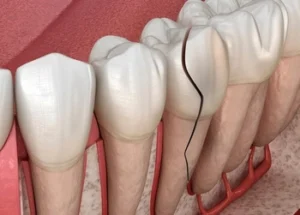
Causes of Cracked Teeth
Broadly, fractured teeth develop in one of two ways. The first is repetitive long-term impact, the gradual wear and tear of thousands of ordinary bites, which slowly fatigues the tooth until a crack appears. The second is a single excessive blow, hard enough to split the tooth into pieces in one moment. Both routes are common, and the practical difference matters, because the gradual route gives you years of opportunity to intervene while the sudden route gives you none.
Accident or a sudden fall
An accidental fall, a collision on the sporting field or a blow during gameplay all sharply increase the risk of a split tooth. The force arrives instantly and concentrates on a small area, which is exactly the loading pattern teeth handle worst. A custom-fitted mouthguard is a sensible precaution for anyone playing contact or ball sports.
Teeth grinding (bruxism)
Continuous clenching and grinding exert sustained pressure on the teeth, far beyond what normal eating produces. Over an extended period this causes real wear and tear on the biting surfaces and within the tooth structure itself. Stress-induced clenching is particularly common, and because it usually happens overnight or unconsciously during the day, most people who do it have no idea until a dentist points out the pattern of wear. Grinding steadily weakens teeth and leaves them exposed to breakage.
Biting hard objects
Teeth have a limited bearing strength. When stress goes beyond that limit, the result is a split or a fracture. Ice, unpopped popcorn kernels, hard lollies, olive pits and bones are the usual suspects. So is the habit of using teeth to open product packaging, which places a sudden and awkwardly directed force on a tooth that was never designed for it. Even when nothing breaks immediately, biting hard objects tends to create micro-cracks that expand quietly over time if nothing is done about them.
Age-related weakening
Enamel weakens gradually over the years, which leaves teeth increasingly exposed to fracture risk. That risk roughly doubles when oral hygiene has not been practised consistently, because decay undermines the tooth from within while the enamel thins from without. The combination of poor hygiene and gradual enamel weakening is a common origin story for hairline cracks that quietly undermine the strength of a tooth long before anything hurts. Untreated decay plays a significant part in this, since a tooth hollowed out by a cavity has far less structure left to resist a bite.
Classification of Causes by Force Strength
It helps to think of these causes in order of how much damage they typically do, ranked by the force profile involved:
- Accident or sudden fall (highest risk). Acute, high-impact trauma applied instantly. Relative risk: very high.
- Biting hard objects. Sudden, concentrated force that exceeds the tooth's tolerance. Relative risk: high.
- Teeth grinding (bruxism). Repetitive, chronic pressure applied over extended periods. Relative risk: moderate to high.
- Age-related weakening (lowest risk). Gradual enamel degradation and cumulative wear. Relative risk: moderate.
The ranking is useful for prevention. The top two causes are largely about protection and habit. The bottom two are about maintenance, which is where regular check-ups and cleans earn their keep.
Types of Cracks in Teeth
Not every crack behaves the same way, and the type of crack largely determines the treatment.
Hairline cracks
These resemble fine hairline patterns across the tooth enamel, sometimes called craze lines. They are not usually accompanied by any discomfort at all. They form with age or through careless biting habits, and in most cases they are a cosmetic finding rather than a structural problem.
Fractured cusps
A cusp is one of the pointed peaks on the biting surface of a tooth. A fractured cusp is the pointed shape that results when a piece of the tooth cleaves away, usually while chewing food. It is often found at the adjoining area between two teeth. Over time, a fractured cusp may cause sensitivity to hot or cold liquids, so the first thing many people notice is discomfort with their morning coffee or a cold drink.
Cracked molar teeth
Cracked molars are common even among people who never go near a high-impact sport, simply because molars endure the highest grinding load during chewing. Left untreated, a crack in a molar tends to extend towards the root, at which point chewing becomes genuinely painful.
Cracked front teeth
Cracks in the front teeth are more often linked to a sharp blow, from mixed martial arts, boxing or an unexpected scuffle. Enamel weakening is a contributing factor, and decay chipping away at a portion of the tooth can set the stage for a fracture that a healthy tooth might have resisted.
Split tooth
This is the most severe case in the range. The tooth has divided into two pieces, with cracks running right through the structure and into the root, heavily compromising what remains. A split tooth represents the most advanced end of the chip-to-crack spectrum, both in terms of damage and pain, and it needs prompt expert attention rather than watchful waiting.
Signs and Symptoms of a Cracked Tooth
Sharp pain
The classic symptom is intermittent sharp pain, particularly while chewing. The discomfort is often more perceptible when the biting pressure is released rather than when it is applied, which is a strong clue that a crack is flexing open and shut under load.
Sensitivity to hot and cold foods
A fracture exposes the inner layers of the tooth. Once that happens, a slight physical touch or contact with hot or cold food and liquids can trigger a sensitivity response. If sensitivity is your main complaint rather than outright pain, our guide to tooth pain relief covers safe short-term measures while you arrange an appointment.
Swelling around the gums
When the impact of a crack reaches the root, it can cause inflammation at the gum line. The resulting swelling brings irritation to the surrounding areas of the tooth and is often the first visible sign that something more than surface damage has occurred.
A feeling of shifting teeth
Loosening is a common aftermath of a crack. A loose tooth shifts unevenly during chewing, which feels strange long before it looks like anything. That sensation signals that a rupture has occurred in the tooth structure and should be assessed promptly.
Why Don't Cracks in Teeth Hurt Initially?
The answer lies in the anatomy. Tiny hairline cracks remain within the enamel, and enamel contains no sensory nerves at all. With nothing to register the damage, there is almost no discomfort in the early stages.
Pain arrives at one of two moments: when the crack extends far enough to reach the pulp, where the nerve sits, or when biting causes the cracked segments of the tooth to move against each other. That is why a crack can sit silently for months and then seem to appear overnight. It did not appear overnight. It simply crossed the threshold where the nerve could finally feel it.
How a Cracked Tooth Is Diagnosed
Because many cracks are invisible, diagnosis usually combines several techniques rather than relying on any single one.
- Visual examination. Using a dental mirror and a torch, the dentist looks for hair-like lines or structural irregularities. This is the starting point whenever the naked eye alone fails to catch the presence of a rupture.
- Dental explorer. A finely engineered pointed instrument is glided along the tooth surface. When the tip encounters a crack or an irregularity, it feels caught rather than sliding smoothly across, which helps locate damage that cannot be seen.
- Bite test. You bite down on a small tool or a piece of test material. A sharp twinge felt on releasing the biting force gives a strong indication of a fracture, and repeating the test on individual cusps helps identify exactly which part of the tooth is involved.
- X-rays. A crack itself may not show on a radiograph, but digital X-rays reveal the secondary signs of cracked tooth syndrome, including inflammation, bone loss and infection around the root.
- 3D imaging (CBCT). A cone beam CT scan provides a detailed three-dimensional view of the tooth and the surrounding bone. It is an advanced diagnostic technique, generally reserved for cases where the simpler methods leave questions unanswered.
Why Early Detection of Cracks Matters
Cracks progress silently. That single fact is the reason early detection matters so much. Caught at an early stage, a crack is straightforward to manage, often with a conservative restoration that leaves most of the natural tooth intact. Detected early, it can be stopped before it extends into the root or the pulp, which is the point at which treatment becomes significantly more involved.
Waiting rarely improves the situation. A crack that could have been bonded in one visit can, over a year of ordinary chewing, become a crack that requires root canal therapy and a crown, or in the worst case a tooth that cannot be saved. This is also why routine examinations are worth keeping even when nothing hurts, since a dentist checking a tooth under good light and magnification will often spot a crack years before you would.
Treatment Options for a Cracked Tooth
Treatment follows the diagnosis, and the right approach depends entirely on how deep the crack runs and how much sound tooth structure remains.
Dental bonding or fillings
Minor cracks are typically treated with a tooth-coloured bonding material that covers the damaged area. Bonding restores both the appearance and the function of the affected tooth and can often be completed in a single appointment. For small fractures and chips, a filling or composite restoration is frequently all that is needed.
Dental crowns
A crown is recommended when the tooth has become structurally compromised. It covers the cracked tooth entirely, shields it from further damage, provides support for proper function and relieves the discomfort that occurs during normal chewing and eating. Our crowns and bridges service covers this in more detail. Crowns are particularly valuable for molars, where the biting forces that caused the crack in the first place are still going to be applied every day.
Root canal therapy
When a crack extends into the pulp, the sensitive nerve area at the centre of the tooth, root canal therapy is usually the priority. The aim is to eliminate the infection and inflammation within the pulp and address cracked tooth syndrome at its source, so that the natural tooth can be kept rather than lost. If you would like an idea of what this involves financially, our overview of root canal cost in Australia sets out the general market ranges.
Tooth extraction
Extraction is the last resort. A dentist turns to it when saving the tooth is simply not viable, for instance when the tooth has been deformed beyond repair or its function cannot be restored. It is considered only after the restorative options have been ruled out, and where a tooth is removed, replacement options such as implants, bridges or dentures can then be discussed.
A note on cost: the cost of treating a cracked tooth is governed by the position of the tooth, the extent of the fracture and the location of the practice within Australia. Because those variables differ so much from case to case, an accurate figure can only follow an examination. Suitability for any of these treatments, and the results you can expect, always depend on an individual assessment.
When to See a Dentist
A lightly cracked tooth often causes no discomfort at first, and that is precisely the trap. The crack advances gradually over time, and the longer it is left, the fewer conservative options remain.
Treat the following as red flags that warrant prompt expert assistance:
- Sharp pain when chewing, especially on releasing the bite
- Sensitivity to hot or cold that lingers
- A sensation that a tooth is budging or shifting
- Swelling around the gum line near a particular tooth
- A visible chip, line or missing fragment of tooth
If a tooth has broken suddenly, if there is significant pain, or if you have had a knock to the mouth, do not wait for a routine appointment. Footscray Dental Studio keeps time available for emergency dental care at our Barkly St practice, and we see patients from across Footscray and Melbourne's inner west, including Seddon, Yarraville and Maribyrnong.
Frequently Asked Questions
How do you fix a cracked tooth?
A permanent fix requires a dentist. Depending on how deep the crack runs, the options are bonding, a crown or root canal therapy. Minor surface cracks generally need only a simple restoration, while severe fractures call for more advanced treatment. Seeing a dentist promptly helps prevent the crack from spreading and becoming harder to repair.
Does a cracked tooth need to be pulled?
Not always. Many cracked teeth can be saved with a crown, bonding or root canal therapy, provided the crack has not reached the root. Extraction becomes necessary only when the tooth has split or the fracture runs deep below the gum line. Your dentist will determine the best option after examining the severity and location of the crack.
How much does it cost to fix a cracked tooth?
Cost depends on the severity of the crack and the treatment required. Minor cracks repaired with bonding or a simple filling sit at the more affordable end. More serious fractures needing a crown or root canal therapy cost more, and extraction followed by a replacement such as an implant is generally the most expensive path. A dentist can give you an accurate estimate only after an examination.
How does a dentist fix a cracked tooth?
The dentist first assesses how deep and extensive the crack is, usually with X-rays and bite tests. Minor cracks are repaired with bonding or a filling. Moderate fractures are typically protected with a custom crown. If the crack has reached the pulp, root canal therapy is needed, and where the tooth has split or the fracture extends below the gum line, extraction may be the only remaining option.
How do you repair a cracked tooth at home?
You cannot repair a crack permanently at home. What you can do is manage the discomfort until you are seen: rinse with warm salt water, avoid chewing on the affected side, and use over-the-counter pain relief according to the packet directions. Temporary dental wax can cover a sharp edge that is irritating your tongue or cheek. Only a dentist can repair the crack itself and stop it worsening.